Car transmission history in numbers: the key figures
Many of the cars pulling into a repair bay today carry a transmission design that didn't exist when the shop first opened. The manual gearbox, the four-speed automatic and the six-speed that followed it each had a run as the standard, and each was pushed aside by something with more gears or no fixed gears at all. This article lays out the evolution of car transmissions as a set of numbers: when the big firsts happened, how fast the manual faded, and what's actually inside a new vehicle built in the most recent model year.
Nearly all of the production figures come from the EPA Automotive Trends Report, which records the transmission in every new light-duty vehicle sold in the United States since model year 1980. Where a historical first is cited, it comes from the manufacturer or an automotive history reference, and every figure is listed again with a link in the Sources section at the end.
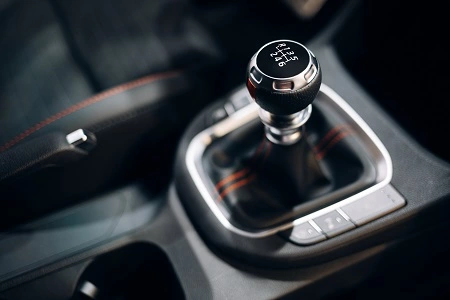
Share of new US light-duty vehicles built with a manual transmission in model year 2024, down from 34.6% in 1980
EPA Automotive Trends Report, 2026
Option price of the Hydra-Matic on the 1940 Oldsmobile, the first mass-produced fully automatic transmission
Mac's Motor City Garage, 2021
Average number of gears in a new vehicle's transmission in model year 2024, up from 3.5 in 1980
EPA Automotive Trends Report, 2026
How the manual transmission faded, decade by decade
In model year 1980, 34.6% of new vehicles built for the US market had a manual transmission, and the three-speed automatic was the most common alternative. The manual's share fell in every decade after that. The figures below are production shares from Table 4.5 of the EPA report, which counts every new light-duty vehicle, not just passenger cars.
The year Cadillac and LaSalle introduced synchromesh, the mechanism that let ordinary drivers shift a manual without grinding the gears.
Jalopnik, 2026
Manual share of new US vehicle production in model year 1990, down from 34.6% in 1980 and 26.5% in 1985.
EPA Automotive Trends Report, 2026
Manual share in model year 2010, after the four-speed automatic had spent 25 years as the most popular transmission.
EPA Automotive Trends Report, 2026
Manual share of production in every model year since 2021, with preliminary model year 2025 data at 0.6%.
EPA Automotive Trends Report, 2026
Number of new models Cars.com found offered with a manual transmission for model year 2025 across every brand sold in the US. Most are sports cars, hot hatches and a handful of trucks, and many are the only manual in their maker's lineup.
Cars.com, 2025
The reason isn't only buyer preference. The EPA notes that automatics were once less efficient than manuals because of torque converter losses and fewer gears, but both types added gears over time and automatics added them faster. In model year 2012, the average gear count of a new automatic passed the average for a new manual, and the efficiency argument for the stick shift went with it. If you're weighing the two for your own next vehicle, TMT's guide to choosing between manual and automatic covers the ownership side of that decision.
Automatic transmission milestones and the race for more gears
The automatic transmission arrived as a luxury option and ended up in more than 99% of new vehicles by 2022. These are the firsts that mattered, with the year each reached production.
- 1939: GM introduces the Hydra-Matic as a $57 option on the 1940 Oldsmobile. It had four forward speeds, a fluid coupling instead of a clutch pedal, and no shifting by the driver once under way.
- 1948: Buick's Dynaflow puts a torque converter at the heart of a passenger-car automatic, the layout almost every conventional automatic still uses (Mac's Motor City Garage, 2020).
- 2006: Lexus unveils the LS 460 with an eight-speed automatic, which Toyota called a world first, for sale that fall as a 2007 model (Toyota Motor Corporation, 2006).
- 2013: ZF's 9HP, which ZF calls a world innovation with nine speeds, reaches buyers in the 2014 Range Rover Evoque and Jeep Cherokee (Motor Authority, 2013).
- 2017: The Ford F-150 becomes the first mass-market vehicle sold with a 10-speed automatic, co-developed with General Motors (Green Car Reports, 2016).
The production data shows how quickly each generation took over and then gave way. According to the EPA, the four-speed automatic with a lockup converter became the most popular transmission in model year 1985 and held that spot for 25 years, and over 80% of new vehicles in model year 1999 had a four-speed. The six-speed peaked in model year 2013 at 60% of production and had fallen to 8% by model year 2024. The eight-speed became the most common transmission in model year 2019, and the fleet-wide average gear count crossed 7 in model year 2020.
Manuals are counted inside their gear categories in that chart and add up to 0.9% across all of them. The "4 or fewer speeds" group grew from 1.1% in model year 2016 to 7.2% in 2024 mostly because battery electric vehicles report a single-speed reduction gear rather than a multi-speed transmission. For a repair shop, the practical point is that more than half of model year 2024 vehicles left the factory with eight or more speeds, and those units carry more clutch packs, solenoids and software than the four-speeds they replaced.
CVTs and dual-clutch transmissions by the numbers
Two newer branches grew up alongside the geared automatic. The continuously variable transmission replaces fixed gears with a belt or chain running between variable-width pulleys, and the dual-clutch transmission is a manual gearbox shifted by computer-controlled clutches instead of a pedal.
The CVT reached the US in a mass-produced car with the 1989 Subaru Justy, about three decades after DAF's belt-driven Variomatic appeared in Europe (MotorBiscuit, 2021). EPA data puts non-hybrid CVTs at 1.3% of production in model year 2005, 7.2% in 2010 and 21.3% by 2015, and they have stayed within a few points of that since (EPA, 2026). Volkswagen put the first dual-clutch gearbox built for large-scale production into the 2003 Golf R32, and by 2018 more than 26 million buyers of Volkswagen and Group models had chosen a DSG (Volkswagen, 2018). Because automakers don't report DCTs to the EPA as a separate category, they show up in the data as a rise in automatics without a torque converter, from 0.1% of production in model year 2005 to 11.5% in 2024.
Share of model year 2024 production with a CVT, combining 20.8% conventional CVTs and 7.8% hybrid CVTs.
EPA Automotive Trends Report, 2026
Share of new cars (not trucks) built with a CVT in model year 2020, against 15% of light trucks.
US Department of Energy, 2021
What this history means for the vehicle in your driveway
The car or truck you drive now most likely has one of three things under it: a six-speed from the 2010s peak, an eight-speed or higher from the last few model years, or a CVT. Each ages differently. A six-speed automatic with a lockup converter is a known quantity for any experienced rebuilder. Eight-, nine- and ten-speed units pack more clutch packs and solenoids into the same housing and depend heavily on software and fluid condition. CVTs rely on belt and pulley surfaces that contaminated fluid can wear quickly, which is why TMT's CVT vs. automatic comparison puts so much weight on fluid service.
Whatever generation you own, the fix for most problems costs less the earlier it's caught. Trans Medic Transmissions rebuilds every one of these designs, from four-speed automatics in older trucks to ten-speed units in late-model Fords and GMs, and can run a fluid analysis, pressure test and road test on a shifting complaint before it turns into a rebuild. A worn solenoid or degraded fluid caught at the diagnostic stage is a far smaller job than the rebuild it turns into if ignored.
Sources
- The 2025 EPA Automotive Trends Report (full report; Table 4.5 and Figures 4.24 to 4.26), US Environmental Protection Agency, February 2026.
- FOTW #1280: More than 99% of all light-duty vehicles produced in 2022 came with automatic transmissions, US Department of Energy, 2023.
- FOTW #1185: Nearly one-third of all light-duty trucks and 7% of cars produced in model year 2020 had 9- or 10-speed transmissions, US Department of Energy, 2021.
- Inside the 1940 GM Hydra-Matic, the first modern automatic transmission, Mac's Motor City Garage, 2021.
- Inside the Buick Dynaflow, Mac's Motor City Garage, 2020.
- Why synchromesh transmissions were so revolutionary, Jalopnik, 2026.
- Lexus unveils fourth-generation LS 460 flagship sedan at Detroit Motor Show, Toyota Motor Corporation, January 10, 2006.
- 9-Speed Automatic Transmission (product page), ZF Friedrichshafen AG, accessed October 2026.
- 2014 Range Rover Evoque: driving the new nine-speed automatic, Motor Authority, 2013.
- 2017 Ford F-150: new 10-speed automatic transmission, 3.5-liter EcoBoost V-6, Green Car Reports, 2016.
- 15 years of Volkswagen dual clutch gearboxes: DSG heralded the success story of automatic transmission in Europe, Volkswagen AG press release via Automotive World, December 5, 2018.
- 1989 Subaru Justy brought the CVT to the U.S., MotorBiscuit, 2021.
- Which new cars have manual transmissions?, Cars.com, June 2025.
FAQ
When Was the First Automatic Transmission Car Sold?
General Motors introduced the Hydra-Matic in October 1939 as a $57 option on the 1940 Oldsmobile, and it's generally regarded as the first mass-produced fully automatic transmission. It used four forward speeds and a fluid coupling, so there was no clutch pedal and no shifting once the car was moving. Cadillac and Pontiac followed, and GM licensed it to other makers including Hudson, Nash and Rolls-Royce (Mac's Motor City Garage).
What Percentage of New Cars Are Manual Today?
According to the EPA Automotive Trends Report, manual transmissions were in 0.9% of new US light-duty vehicles in model year 2024, and they've been below 1% every year since model year 2021. Preliminary data for model year 2025 puts the figure at 0.6%. For comparison, the share was 34.6% in 1980 and 9.7% in 2000. Cars.com counted fewer than 30 new models with a manual for model year 2025.
How Many Gears Do Modern Automatic Transmissions Have?
The fleet-wide average reached 7.0 gears in model year 2024, up from 3.5 in 1980, per the EPA. Eight-speed automatics were the most common single type at 33.2% of production, and transmissions with nine or more speeds made up another 20.5%. Six-speeds, which peaked at 60% of production in 2013, had fallen to 7.9%. CVTs don't have fixed gears at all and accounted for 28.6% of new vehicles.
Is a CVT Considered an Automatic Transmission?
From the driver's seat, yes: a CVT has no clutch pedal and selects its own ratio. Mechanically it's different, because it uses a belt or chain between variable pulleys instead of planetary gearsets and clutch packs. The EPA tracks CVTs separately from geared automatics for that reason, and splits them into conventional and hybrid types. TMT's CVT vs. automatic guide explains how the two differ in maintenance and repair.